
Darnel


Since I've moved to S's church, I've been reading D.James Kennedy's Evangelism Explosion for their evangelistic training class.

In his book, he provided an explanation of the parable of the wheat and tares that is extremely epiphanic. He wrote:

"The church in this world is always a mixed multitude of believers and unbelievers. In the parable of the wheat and tares, Jesus indicated that this condition would continue to the end of time. In the world to come, at the judgment, the distinction will be made. It is interesting that Jesus draws a contrast between wheat and darnel. The darnel looked exactly like a wheat through all stages of growth until the time of harvest. Then it had no "fruit". Perhaps there is the implication here that those who do not bear fruit are not true believers."

I really am no agricultural expert and perhaps listening to this parable in a non-agrarian society means we are unable to appreciate the comparison. This has happened to me before with the parable of the mustard seed (hint: the mustard seed cannot grow into a tree).

I checked up this story on Wikipedia and lo and behold (https://en.wikipedia.org/wiki/Lolium_temulentum)

"Darnel usually grows in the same production zones as wheat and was a serious weed of cultivation until modern sorting machinery enabled darnel seeds to be separated efficiently from seed wheat.[1] The similarity between these two plants is so great that in some regions, darnel is referred to as "false wheat".
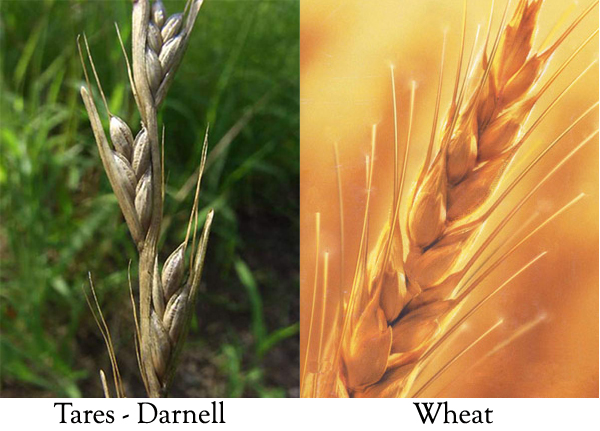
Related image

Comments

Popular posts from this blog

The Inclusio of the Book of Matthew

From wikipedia: "In literature, inclusio is a literary device based on a concentric principle, also known as bracketing or an envelope structure, which consists of creating a frame by placing similar material at the beginning and end of a section, although whether this material should consist of a word or a phrase, or whether greater amounts of text also qualify, and of what length the frames section should be, are matters of some debate. Inclusio is found in various sources, both antique and new." The Inclusio of the Book of Matthew is that it starts and ends with "Immanuel". At the start, after the genealogies we are told that Jesus fulfills the prophecy of Isaiah (Matt 1:22-23). "All this took place to fulfill what the Lord had spoken by the prophet: “Behold, the virgin shall conceive and bear a son,     and they shall call his name Immanuel” It then ends with "Immanuel" being fulfilled in the act of discipling. "G...

The use of Psalm 68:18 in Ephesians 4:8

  For Paul in Ephesians 4:8, clearly there are some changes from the text that Paul is supposedly citing which is Psalm 68:18. Comparing Psalm 68:18 and Ephesians 4:8, it is obvious there are differences. I believe Paul was actually using the LXX but has changed its words for the occasion in Ephesians 4. The LXX version of Psalm 68:18 and Ephesians 4:8 differs by a few words: Psalm 68:18 (it is actually Psalm 67:19 in the LXX): ἀναβὰς εἰς ὕψος  ᾐχμαλώτευσας  αἰχμαλωσίαν, ἔλαβες  δόματα  ἐν ἀνθρώπῳ , Ephesians 4:8 ἀναβὰς εἰς ὕψος  ᾐχμαλώτευσεν  αἰχμαλωσίαν,* ⸆  ἔδωκεν  δόματα ⸀ τοῖς ἀνθρώποις. Structurally you can see the LXX and Eph 4 is similar but for a few words changes.   The first change is from 2nd person (LXX) to 3rd person (Eph 4) with regards to who is doing the ascending in the first line.  So the English Bible rightly translates the phrase to "When  he  ascended on high" versus Psalm 68, " you  ascended" ...

Did Jesus quote a non-existent verse in John 7:38?

So this was asked in Quora : My response below: The verse is NOT non-existent. The thing is the reference to a river flowing out occurs in a few places in the Old Testament. Thus when Jesus says "As the Scripture has said ..." He is referring to a theme that occurs repeatedly in the Old Testament. It is important to understand what "the rivers flowing out" imply in the Old Testament. They always refer to the  dwelling place of God . These occurs in a few places. As early as the Book of Genesis, we see this Scripture in Genesis 2:10 "A  river flowed out of Eden  to water the garden, and there it divided and became four rivers." (Genesis 2:10, ESV) Therefore, the source of the river = Eden. And Eden is none other than the very dwelling place of God. Biblical theology helps us understand Eden as a "type" of temple. Where else do we see this? We see this again in Ezekiel 47. In Ezekiel 47, in Ezekiel's vision of a New Temple, he pi...